
NUVEEN MUNICIPAL VALUE FUND INC (NUV) Stock Analysis
NUVEEN MUNICIPAL VALUE FUND INC
How to read NUV (pre-profit growth)
This company is reinvesting instead of generating profit, so a standard DCF cannot price it. The useful question is whether the growth the market is paying for is achievable — and whether the company can fund itself until then.
-
1
Reverse-DCF — the growth the price demands ↓
It shows exactly how fast the business must grow to justify today's price. Compare that to what comparable companies have actually achieved.
-
2
Cash runway ↓
Can it reach profitability before it has to raise money and dilute shareholders?
-
3
Interactive calculator ↓
Set your own growth + margin assumptions and see what the business would be worth if you are right.
It files little or nothing with the SEC — so our cash-flow models, financial statements, and U.S. insider data (Form 4) don't apply. What's still real: the live U.S. price and short positioning. Here's what we could pull from other sources:
Nuveen Municipal Value Fund Inc.
📑 Read the real filings: latest SEC 8-K ↗
Identity, share count and tier from FINRA + OTC Markets; not a substitute for the home-market financial statements. Thin U.S. disclosure + OTC trading is itself a risk factor.
Quality & solvency checks
Cheap stocks can be cheap for a reason. These screens warn when a low valuation comes paired with structural fragility.
Why it matters: Cheap-looking stocks (low P/E or P/B) often have low Z-scores because the market knows the company is dying. Z-score warns you before you fall into a value trap.
Reference: > 3.0 = safe zone · 1.81–3.0 = grey zone · < 1.81 = distress zone
Full explanation →
The Z-score needs working capital, retained earnings, EBIT, sales and total assets from the latest balance sheet, and at least one of those isn't reported in machine-readable form here — common for foreign private issuers. We leave it blank rather than compute a distress verdict from an estimated input. It doesn't affect the reported figures in the financial tables below.
Why it matters: High score = fundamentals improving. Low score = deteriorating. Especially powerful for filtering cheap stocks: cheap + high F-score historically outperforms; cheap + low F-score is often a value trap.
Reference: 7–9 = strong · 4–6 = mediocre · 0–3 = weak
Full explanation →
The F-score compares two consecutive years of income, cash-flow and balance-sheet data. We have 0 years of income data for this filer, but no machine-readable cash-flow statement or balance sheet — so several of the nine checks have no input at all. We show nothing rather than score a partial year against itself. The reported figures in the financial tables below are unaffected.
A standard discounted cash flowDCF — Discounted Cash Flow — sums up all future cash a business will produce, adjusted for the fact that future dollars are worth less than dollars today.
Why it matters: It is the most fundamentally honest valuation method when applicable — but only works for companies with predictable, positive cash flow.
Reference: Best for: mature, profitable businesses. Fails for: pre-profit growth, banks, REITs.
Full explanation → (DCF) valuation is not meaningful for Nuveen Municipal Value Fund Inc. because the model projects negative free cash flowFree Cash Flow (FCF) — Operating cash flow minus capital spending: cash left after a company covers operating costs, taxes and interest and reinvests in the business — but BEFORE repaying debt principal or paying dividends. The cash actually available to investors.
Why it matters: A company can show big profits on paper while burning through cash. FCF is what actually fills the bank account.
Reference: Healthy mature businesses convert 8–15% of revenue into FCF · Growth companies often negative
Full explanation →, indicating it's not generating sufficient cash from operations. The model implies no positive equity value under current assumptions, suggesting valuation is speculative. Investors are likely focused on the fund's income generation and portfolio stability rather than growth, as it's a closed-end fund. The primary quantifiable risk is the fund's 'Franchise/durability score 0/5', indicating a lack of sustainable competitive advantages.
As of 3 months ago
Anatomy of a share
What you're buying per share. Bars are at the same scale so you can see the relative size of revenue, costs, cash flow, and debt — not just read them in a table.
What you actually need to decide
Every stock price is a disagreement. Here's the single thing that must go right for the bulls, the single thing that breaks the thesis, and the concrete signposts to watch so you can update your view as real results arrive.
- Changes in distribution rates
- Trends in Net Asset Value (NAV)
- Credit quality of underlying municipal bond holdings
Management & Leadership
Nuveen Municipal Value Fund Inc. is managed by Nuveen, a subsidiary of TIAA. William C. Forsyth Jr. is a key portfolio manager for Nuveen's municipal bond funds, overseeing strategies that include the Municipal Value Fund. His tenure with Nuveen spans several decades, providing continuity in the fund's management approach.
What They Make
Nuveen Municipal Value Fund Inc. is a closed-end management investment company that invests primarily in a diversified portfolio of municipal bonds. These bonds are typically purchased by investors seeking tax-exempt income.
End Markets
Revenue Drivers
Why Is It Priced Like This?
Why Customers Pay
The income statement and balance sheet are also too incomplete here to substitute another lens honestly, so this page carries price, momentum and disclosure facts only.
The market is likely pricing NUV based on its ability to generate consistent tax-exempt income and the stability of its underlying municipal bond portfolio, rather than traditional cash flow metrics. The 'FCFFree Cash Flow (FCF) — Operating cash flow minus capital spending: cash left after a company covers operating costs, taxes and interest and reinvests in the business — but BEFORE repaying debt principal or paying dividends. The cash actually available to investors.
Why it matters: A company can show big profits on paper while burning through cash. FCF is what actually fills the bank account.
Reference: Healthy mature businesses convert 8–15% of revenue into FCF · Growth companies often negative
Full explanation → negative' flag indicates that a standard DCFDCF — Discounted Cash Flow — sums up all future cash a business will produce, adjusted for the fact that future dollars are worth less than dollars today.
Why it matters: It is the most fundamentally honest valuation method when applicable — but only works for companies with predictable, positive cash flow.
Reference: Best for: mature, profitable businesses. Fails for: pre-profit growth, banks, REITs.
Full explanation → model is not appropriate, and investors are likely more focused on distribution yield and net asset value (NAV) performance. The market may be assigning value to the fund's ability to navigate interest rate changes and credit risks within the municipal bond market, which is not in the model.
Business Model & Valuation
How They Make Money
The fund typically distributes income to shareholders, consistent with its objective of providing tax-exempt income, rather than focusing on buybacks or equity raises.
Growth / Revenue DCF
No cash flow statement data available - using revenue/margin growth model as fallback.
Show advanced inputs
| Revenue Growth | 15.0% |
What this model does NOT do: this is a consolidated owner-earnings FCF model. Standalone segment assumptions: none. It does not project its revenue segments independently; their combined effect is embedded in the historical revenue and cash-flow trend the model extrapolates. The calculator above can only approximate a segment's impact through the single consolidated growth rate — it cannot model any one line separately. For a true segment-level view, build a separate model from the company's segment disclosures.
Maturity & Competitive Position
Moat Signals
Geography & Markets
Nuveen Municipal Value Fund Inc. invests in municipal bonds issued by entities across the United States. The specific geographic mix of its bond holdings is not available from current data sources but would reflect a diversified exposure to various U.S. states and municipalities.
Geographic Risks
Market Signals
These are timing signals, not value signals — they describe the stock's recent price behavior, not what the business is worth. Use them for the "the thesis looks good, but is now the moment?" question. Each tile below explains what it's saying.
Why it matters: Short-term contrarian indicator. Extreme readings often precede mean reversion, though not always.
Reference: 30–70 normal · >70 overbought · <30 oversold
Full explanation → (14)52.8NeutralMomentum is balanced — neither overbought nor oversold.
Why it matters: When the fast line crosses above the slow line, short-term momentum is turning up; below, turning down. A timing cue, not a value signal.
Reference: Line above signal = bullish momentum · below = bearish
Full explanation →BullishLine above signalThe fast trend is above the slow trend — short-term momentum is currently upward.
Technicals describe price, not the business. A great company can have a "bearish" tape (a buying chance) and a weak one a "bullish" tape (a trap). Pair these with the valuation and health sections above.
QUALITY
Data Quality & Risk Flags (8 notes — click to expand/collapse)
Guardrail Notes (8)
- FCF negative: revenue/margin growth model projects future cash flows from revenue trajectory.
- INVARIANT: weighted IV is non-positive. Model may not be appropriate.
- Model implies no positive equity value under these assumptions. Valuation is speculative/low-confidence.
- Shares from unknown — per-share values may be less accurate.
- Illiquidity discount 25% applied (small/micro-cap — harder to exit, demand a margin).
- Shares/market cap missing or defaulted; per-share valuation unreliable.
- Shares defaulted to 1; IV is NOT meaningful — treat as data-unavailable.
- DATA UNAVAILABLE: per-share values suppressed due to missing/unreliable shares data.
FINANCIALS
Financial Statements (5-year tables — click to expand)
From NUVEEN MUNICIPAL VALUE FUND INC's SEC filings (EDGAR).
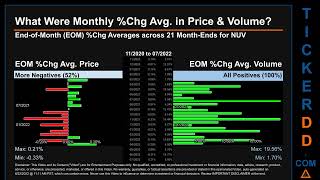
Recent video coverage
Top recent YouTube videos by date. We don't endorse the channels — these are surfaced for context.
Similar companies worth a look
Same sector and industry, similar fundamentals shape. Verify everything yourself — this list is computed mechanically and does not reflect our judgment about whether any of these are a good investment.